
Specific opportunities are listed here when open – but if you are interested in working with the group and there is not something specific, please get in touch! See the notes below on general opportunities before reaching out.
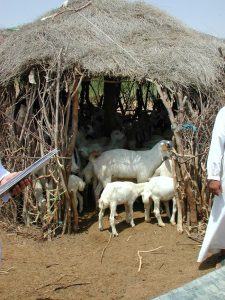
Goats in the shade of a thatched hut during an investigation into a Rift Valley fever outbreak in Saudi Arabia, 2000. Courtesy CDC/Abbigail Tumpey
Closing date: Tuesday, 8th December 2026
Mathematical and computational methods to discover and characterise critical genetic features in RNA viruses, with application to Rift Valley Fever Virus
Want to help develop the next generation of methods to find biology hiding in virus RNA, whilst discovering what is in a virus that causes livestock outbreaks and infects humans? Ready for PhD study? This may be for you!
The project is mainly computational, with collaboration with veterinary colleagues and potentially a trip near to the East African Rift Valley to understand better the impact of the virus in a real-world context.
This is a funded project within the Cambridge Biosciences DTP PhD Programme. It is open to home and international students.
Official information for prospective applicants here (disclaimer: where the group website and official information conflict, the official information takes precedence).
Contact Jordan if you would like to discuss further/are thinking of applying.
There are many ways to work with the group, and the list here is extensive, but not comprehensive! If you are interested in working with the group but not sure what category below you would fall into, please read the general advice below and then make contact.
The group is based in the Department of Pathology and can offer computationally-based Part II projects – do make contact if you would like to use your project time to explore this type of research.
Want to explore mathematical/computational virus research in more detail whilst spending a summer in Cambridge? We have previously hosted students taking a range of undergraduate degrees. Projects typically last eight weeks. Aside from being a research powerhouse, Cambridge is a beautiful city in which to spend a summer, hosting festivals in the arts and music, and less than an hour by train from London.
Because of the cross-disciplinary nature of our research, it is likely that you will need at least the equivalent of two years of undergraduate study in a relevant area (biological sciences, medical sciences, mathematics, or computing) for a summer project to be productive. You do not need to have expertise in all of the disciplines our work crosses – simply experience of enough areas and willingness to develop an interest in the others.
Please note that, as a matter of principle (ensuring students are not excluded on economic grounds), we only take summer students if we are able to find funding to pay you – we have worked successfully with students before to find funding. Funding for summer projects is mostly restricted to students still studying for their degrees (i.e. not the summer after completion). Most external funders require you to be performing at the equivalent of UK first class level to be competitive for funding. If you are a student in Cambridge, additional local funding may be available, where the usual minimum standard is within the 2.1 bracket. Please take the timing of finding funding into account – for a summer project it is usually best to start around January time.
Want to use the project or dissertation component of your course to try out the group?
- M.Phil. in Biological Science (Pathology) by thesis: We are very happy to hear from people thinking about undertaking a one-year research degree. We strongly advise making contact if you are considering making an application, not least to help decide whether the M.Phil. or the Ph.D. is the most appropriate option.
- M.Phil. in Computational Biology: We have previously hosted students for successful projects.
- Part III/M.A.St. Mathematics: Whilst Jordan does not routinely set essays, he would be very happy to discuss a custom topic for anybody considering the field.
- Other Cambridge courses: If you are taking another course with a project or dissertation component, and would like to discuss using that component to explore the group’s research area, please get in touch.
The Ph.D. – usually three or four years in the UK – remains the main degree for beginning a career in research and development, whether in academia or further afield.
The group is open for Ph.D. applications – contact Jordan (see information below) to discuss potential projects.
Working in an area of computational virology related to the group and wanting to develop your own project/begin or continue the transition to independence? Do make contact.
Want to experience research within your student-selected component or elective? Make contact! Please note that the timing of a single SSC is quite tight for making good progress on a project, and be prepared to discuss options that will allow you to reach a good stopping point.
If you are an external (non-Cambridge) student considering an elective with a research-based component in Cambridge, we are very happy to be contacted. If you are thinking about a clinical elective, the group is not the appropriate point of contact: please instead see the information provided by the School of Clinical Medicine.
Jordan specifically supports clinical academic training in Medical Virology, but is happy to speak to (human) clinicians looking for opportunities anywhere in infection, and can do his best to direct you appropriately. For this to be applicable, you will need to be eligible to work as a medical doctor in the United Kingdom (registered with the General Medical Council with a licence to practise).
Jordan is more than happy to give advice to anybody considering a clinical academic career in any area of infection, and suggests a low threshold for making contact early, as post planning is often undertaken far in advance, and UK specialist training has stringent requirements for the stages of training at which doctors are permitted to enter academic programmes.
If you are already on an academic training pathway, and would like to discuss spending an academic block with the group, please make contact with as much notice as possible.
I regularly receive unsolicited approaches regarding possible research positions. Many of these approaches are cut-and-paste and/or propose work that I am not best-placed to support. I do my best to reply to all approaches that have considered and specify why, in particular, you want to work with me, and to all approaches from clinicians wanting to discuss research opportunities in virology in general (which I support as one of my departmental roles).
I do not expect you to understand the detail of my work before an approach to work specifically with me – but please do ensure you have checked the general area is correct if you would like a reply!
If your approach to me is obviously cut-and-paste or appears to be written by AI, then it is unlikely you will receive a reply. Hopefully it is clear why such an approach is not going to lead to me taking time to write a custom reply. Conversely, if you have taken time to consider why you are writing specifically to me, and are clear about what you hope to get from doing so, I shall do my best to construct a helpful response.
General standards and funding
Our work is very cross-disciplinary, which makes it difficult to specify a minimum standard for applicants to work with the group. However, you should be aware that places, and especially funding to work, in Cambridge are internationally competitive, and many people who gain places here are near the tops of their cohorts. I am interested both in your preparation and in your potential.
Areas in which I may be able to support projects
My research is mostly computational/theoretical, and if you want to undertake a bench-based project, it is likely that one of my colleagues in the Division of Virology will be better placed to help. My main area of research is investigating virus genomics from a mathematical perspective, with a long view towards therapeutics for human disease. Please note that whilst my interests cover identifying viral targets for vaccines, they do not extend into the immunological components of vaccine design. If you are a clinician, I may be able to work with you on smaller projects in clinical diagnostics and in system design. I sometimes have educationally-focussed projects available.
How to contact me
By email, having read the above.