
Our main focus is the biology of RNA viruses – an interest crossing disciplines from mathematics into the basic science of molecular virology, through to clinical application.
In keeping with the clinical focus of the group, we also have interests in how viral diagnostics are used clinically, and in how diagnostic laboratories can prepare for surge events such as epidemics and pandemics.
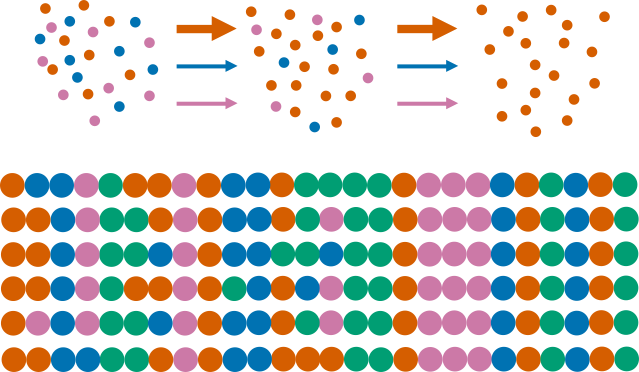
Traits that make an organism more likely to survive and produce progeny become more prominent from generation to generation and eventually appear conserved, whether that is at whole organism level (top), or within the genome (bottom).
We are surrounded by evolutionary success: every organism has characteristics that make it better at surviving and reproducing than competitor organisms that have died out. Genetic sequences contain signatures of these evolutionary successes. We study these genetic sequences in viruses, to find and understand the unique biology that makes them evolutionary successes. By doing this, we discover new biology – and candidate targets for antiviral drugs.
The underlying language to understand genetic sequences is information, and we develop methods in the language of information – the mathematics of probability and statistics. We implement these methods via computational approaches to analyse sequence data.
The viruses we study use RNA as their genetic material. Signatures of important biology in RNA can indicate proteins for which the RNA codes (including multiple, overlapping pieces of code), or can indicate the molecular structures formed by the RNA itself acting to direct the virus lifecycle. Our work therefore moves from mathematical theory into understanding molecular virology and virus lifecycles.
As Jordan is a medical doctor, the viruses we have studied are usually clinically important in human medicine – for example HIV-1, influenza A, SARS-CoV-2.
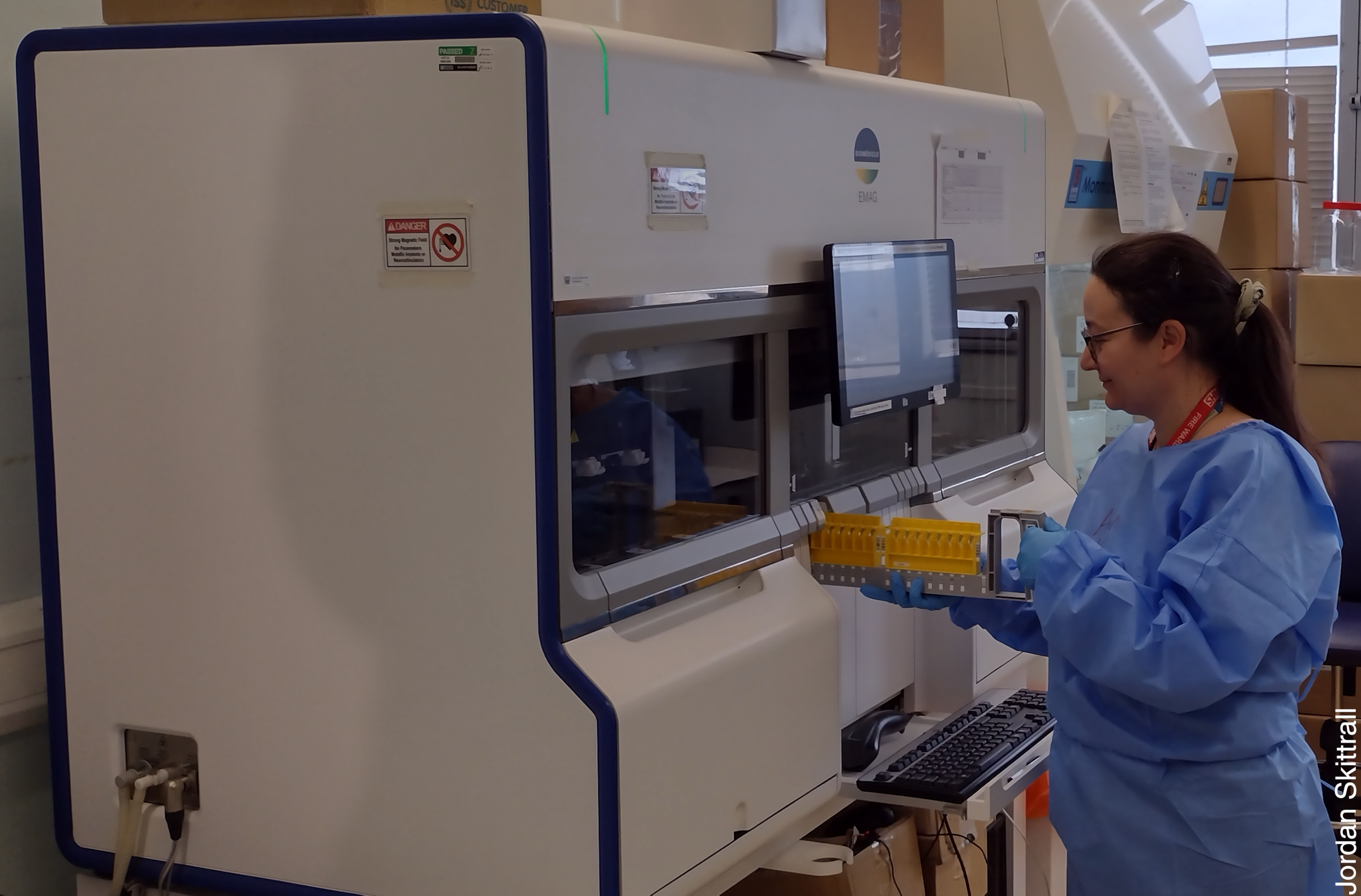
Your laboratory test shows a low positive – is it real? What do you do?
For those of us working in clinical diagnostics, these are questions we deal with many times each day. Often there is a trade-off between accuracy and efficacy – “timely” may beat “perfect.”
Clinical diagnostic assays undergo substantial development before they are allowed into the diagnostic laboratory. But sometimes, it is only when they are used many times, with real patient samples, that we gain enough information to work out the best way to use them.
We work closely with our regional diagnostic laboratory (where Jordan practises) to study outcomes from real-world use of tests, aiming to use those tests better to improve outcomes for patients.
Our work combines the languages of statistics and epidemiology with pragmatic approaches in clinical medicine.

Drawing gifted to Jordan during the COVID-19 pandemic.
How do we design healthcare systems that are lean and efficient during normal service, but adapt rapidly to expand capacity when an emergency arises?
We are interested in how diagnostic capacity responds to outbreaks, epidemics, and pandemics – and improving that response.
This work sits at the interface between how a diagnostic laboratory works (particularly its logistics), the dynamics of infectious disease, and policy.